Sorus Consulting Contact
Open-source platform

TerraLink

Wildlife corridor optimization for fragmented landscapes.

TerraLink is an open-source ecological corridor planning tool for improving connectivity across fragmented landscapes. It is available as a QGIS plugin, R package, and browser-based tool, and it accepts spatial data on habitat patches along with user-defined criteria such as connectivity goals, corridor constraints, and species-specific parameters.

Aerial landscape mosaic with forest patches and open land.
Version chooser

Choose the version that fits your workflow

TerraLink

TerraLink in Browser

Demos, teaching, outreach, quick exploration

Explore TerraLink without installing GIS software. Best for communicating the concept, testing simple examples, and sharing the tool with nontechnical collaborators.

Launch Browser Version

Useful for lightweight examples, training, and outreach.

TerraLink

TerraLink for QGIS

GIS practitioners, planners, consultants, conservation NGOs, agencies

Run TerraLink directly inside QGIS using raster or vector habitat layers. Best for hands-on spatial planning, scenario comparison, and map-based corridor design.

Download QGIS Plugin

Recommended: install from the official QGIS Plugin Repository. A direct SORUS-hosted 1.8.1 zip is also available below.

Download direct zip
TerraLink

TerraLink for R

Researchers, analysts, reproducible workflows

Use TerraLink in scripted workflows for repeatable analysis, batch processing, sensitivity testing, and publication-oriented methods.

Open R Version

CRAN package page for installation details and package metadata.

Release updates

Stay updated on TerraLink

Get notified about new releases, feature updates, and availability across the QGIS, R, and browser versions of TerraLink.

Only TerraLink release updates. Unsubscribe anytime.

Workflow overview

How TerraLink works in practice

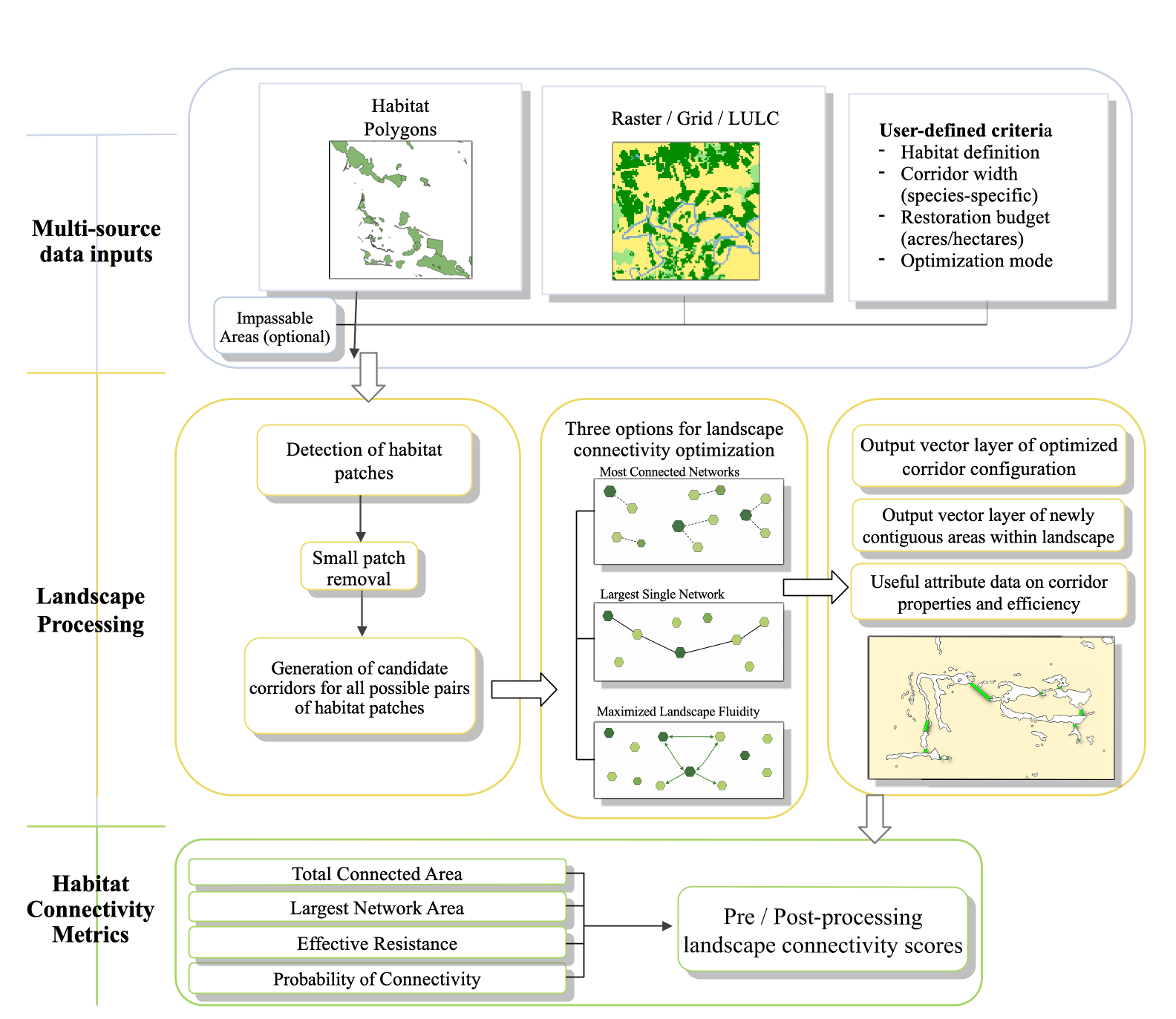
TerraLink accepts either habitat polygons or raster land-cover inputs, applies user-defined ecological and planning criteria, generates candidate corridor options, and returns spatial outputs and connectivity metrics for comparison.

The workflow below shows how patch detection, candidate corridor generation, optimization mode selection, and output metrics fit together in one planning sequence.

TerraLink workflow diagram showing data inputs, landscape processing, optimization modes, output layers, and habitat connectivity metrics.
Conceptual TerraLink workflow from input preparation through optimization outputs and connectivity metrics.
Optimization modes

Different strategies for different planning goals

1

Most Connected Network

Prioritizes high-return corridor choices that connect multiple habitat areas efficiently, often creating several useful networks across the landscape.

2

Largest Single Network

Prioritizes building one dominant connected backbone, useful when the goal is to create a large coherent habitat network.

3

Landscape Fluidity

Prioritizes flow, redundancy, and alternative routes, helping identify corridors that reduce bottlenecks and improve whole-landscape movement potential.

Why it matters

Why connectivity matters

Habitat fragmentation breaks landscapes into smaller and more isolated patches, reducing movement, dispersal, gene flow, and climate adaptation potential. TerraLink is designed to help restoration planners find leverage points where relatively small areas of restored or protected habitat can reconnect larger ecological systems.

Users

Built for people restoring connected landscapes

Restoration plannersConservation NGOsGIS analystsLandscape ecologistsForest and habitat managersResearchersAgencies and land trustsStudents and educators
Open source

Open source and evolving

TerraLink is open source and actively evolving. Feedback, peer review, feature requests, and contributions are welcome, especially from people working on real corridor planning, restoration prioritization, landscape ecology, and conservation technology.